Introduction
Growth is usually a good sign. More customers and sales mean your business is healthy. But growth also adds complexity.
This article is part of our The Complete Guide to AI Agents & Business Automation topic hub. You may also want to read AI Agents vs Traditional Software: The Future of Business Operations, AI ROI: How to Measure Whether Your AI Investment Is Actually Working, How Small Businesses Can Compete Using AI and Automation.
As companies grow, teams handle more data, customer questions, admin work, and daily processes. Systems that worked for a small team often break down at scale.
Many companies hire more staff to keep up. That can help for a while, but it also raises costs and creates new bottlenecks.
This is why automation matters more than ever.
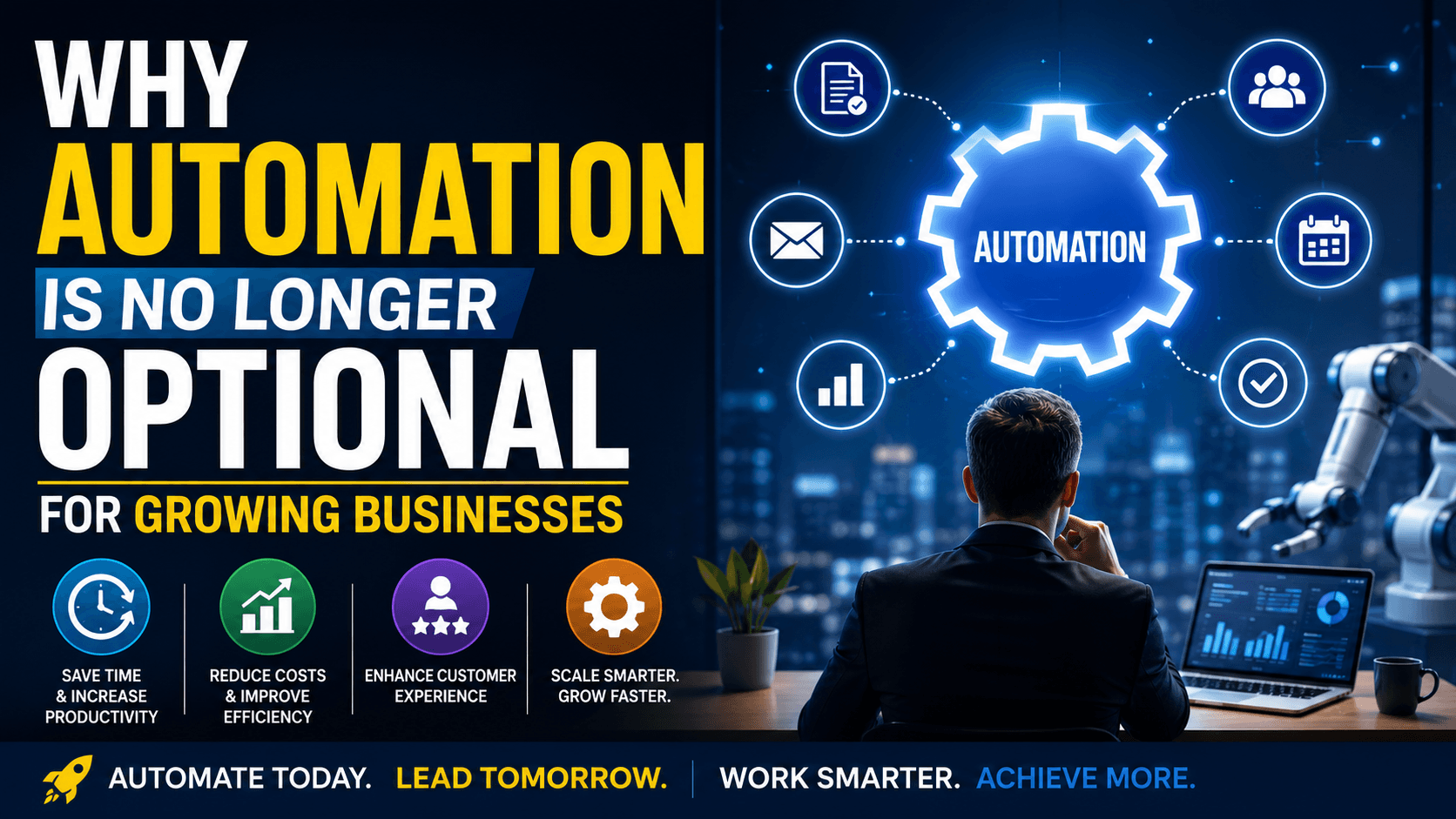
Automation is not just a productivity tool. It helps businesses scale faster, serve customers better, cut operating costs, and free teams for higher-value work.
In this article, we explain why automation is essential for growing businesses and how to use smart systems to stay competitive.
The Hidden Cost of Manual Processes
Most businesses underestimate how much time is spent on repetitive work.
Examples include:
- Copying information between systems
- Scheduling appointments
- Responding to common customer inquiries
- Updating spreadsheets
- Managing lead information
- Creating reports
- Sending follow-up emails
Individually, these tasks may seem minor.
Collectively, they consume hundreds or even thousands of hours each year.
The hidden costs include:
Lost Productivity
Employees spend valuable time performing tasks that could be automated.
Increased Errors
Manual processes often lead to mistakes such as:
- Incorrect data entry
- Missed appointments
- Duplicate records
- Lost customer information
Slower Operations
When humans perform every step manually, business processes become slower and less scalable.
Employee Burnout
Repetitive work reduces job satisfaction and can negatively impact employee retention.
What Is Business Automation?
Business automation refers to using technology to execute tasks and workflows with minimal human intervention.
Automation systems can:
- Collect data
- Move information between systems
- Trigger actions automatically
- Generate reports
- Communicate with customers
- Manage workflows
The goal is not to replace people.
The goal is to eliminate repetitive work so employees can focus on strategic, creative, and customer-facing activities.
Why Automation Matters More Than Ever
Several trends are driving increased automation adoption.
Rising Customer Expectations
Customers expect:
- Faster responses
- Immediate support
- Personalized experiences
- Consistent service
Meeting these expectations manually becomes increasingly difficult as businesses grow.
Automation enables organizations to deliver high-quality customer experiences at scale.
Growing Operational Complexity
Modern businesses often use dozens of software platforms.
Examples include:
- CRM systems
- Accounting software
- Marketing tools
- Customer support platforms
- Scheduling systems
Managing these systems manually creates inefficiencies.
Automation helps connect tools and streamline workflows.
Competitive Pressure
Businesses that automate key operations often:
- Respond faster
- Operate more efficiently
- Reduce costs
- Scale more effectively
Organizations that fail to automate risk falling behind competitors who can move faster and serve customers more effectively.
Areas Where Automation Creates Immediate Value
Customer Support
Customer support teams often receive repetitive inquiries.
Examples include:
- Order status requests
- Appointment inquiries
- Pricing questions
- General information requests
Automation can:
- Route tickets
- Answer common questions
- Escalate complex issues
This improves response times and customer satisfaction.
Lead Management
Sales teams frequently spend time qualifying leads and updating CRM records.
Automation can:
- Capture lead information
- Score leads automatically
- Schedule follow-ups
- Notify sales representatives
This helps businesses respond to opportunities more quickly.
Appointment Scheduling
Manual scheduling creates unnecessary administrative work.
Automation systems can:
- Check availability
- Book appointments
- Send confirmations
- Manage cancellations
- Deliver reminders
This reduces workload while improving customer convenience.
Internal Reporting
Generating reports manually can consume significant time.
Automation can:
- Gather data
- Generate dashboards
- Deliver reports automatically
Leaders receive insights faster and make better decisions.
The Role of AI in Modern Automation
Automation has evolved significantly over the past few years.
Traditional automation relies on predefined rules.
For example:
"If a form is submitted, send an email."
AI-powered automation introduces intelligence into workflows.
Examples include:
Intelligent Document Processing
AI can analyze and extract information from documents automatically.
Natural Language Understanding
Systems can understand customer requests and respond appropriately.
Predictive Decision Making
AI can identify trends and recommend actions.
Voice Automation
AI Receptionists can answer calls, schedule appointments, and assist customers without human involvement.
This combination of automation and AI creates entirely new possibilities for businesses.
Common Automation Opportunities
Every business has automation opportunities.
Examples include:
Healthcare
- Patient appointment booking
- Reminder notifications
- Intake form processing
Restaurants
- Reservation management
- Customer inquiries
- Order tracking
Agencies
- Lead qualification
- Client onboarding
- Project updates
E-commerce
- Order management
- Customer support
- Inventory notifications
Professional Services
- Appointment scheduling
- Document processing
- Follow-up communications
The opportunities are often larger than organizations initially realize.
Automation Does Not Replace Employees
One of the biggest misconceptions about automation is that it exists solely to reduce staffing.
In reality, the most successful businesses use automation to enhance employee productivity.
Automation handles repetitive work.
Humans focus on:
- Innovation
- Relationship building
- Strategy
- Problem solving
- Creativity
This creates stronger teams and more efficient organizations.
Measuring the Impact of Automation
Businesses should track measurable outcomes when implementing automation.
Common metrics include:
Time Saved
How many hours are eliminated each month?
Response Speed
How quickly are customers receiving assistance?
Error Reduction
How many mistakes are prevented?
Customer Satisfaction
Has the customer experience improved?
Revenue Growth
Are automated systems helping capture more opportunities?
These metrics help quantify the return on investment.
Common Automation Mistakes
Businesses often encounter challenges when implementing automation.
Automating Broken Processes
Automation cannot fix inefficient workflows.
Optimize processes before automating them.
Choosing Too Many Tools
Adding excessive software can increase complexity.
Focus on simplicity and integration.
Ignoring User Experience
Automated systems should improve experiences, not create frustration.
Lack of Monitoring
Automation requires ongoing oversight and optimization.
The Future of Business Automation
The next generation of automation will combine:
- AI agents
- Voice AI
- Workflow automation
- Predictive analytics
- Autonomous decision-making
Businesses will increasingly move toward systems capable of managing complex operations with minimal supervision.
Instead of automating individual tasks, organizations will automate entire workflows.
This shift will fundamentally change how businesses operate.
Signs Your Business Needs Automation
You should consider automation if:
- Employees perform repetitive tasks daily
- Customer inquiries are increasing
- Operations are becoming difficult to manage
- Errors are occurring frequently
- Teams spend excessive time on administrative work
- Growth is creating operational bottlenecks
If any of these apply, automation may provide significant value.
Key Takeaways
- Manual processes become expensive as businesses grow.
- Automation improves efficiency, accuracy, and scalability.
- AI-powered automation goes beyond simple rule-based workflows.
- Customer support, scheduling, and lead management are ideal starting points.
- Automation allows employees to focus on higher-value activities.
- Organizations that automate effectively gain a competitive advantage.
Conclusion
Automation is no longer a luxury reserved for large enterprises.
It has become a necessity for businesses that want to grow efficiently, remain competitive, and deliver exceptional customer experiences.
The organizations that embrace automation today will be better positioned to scale tomorrow.
By combining intelligent workflows, AI-powered systems, and integrated technology, businesses can reduce operational friction and unlock new opportunities for growth.
The future belongs to companies that work smarter, not harder.
Ready to Automate Your Business?
At Buztronic, we design and implement intelligent automation systems that connect your tools, streamline workflows, and eliminate repetitive work.
Whether you're looking to automate customer support, appointment scheduling, internal operations, or business processes, our team can help you build systems that scale.
Book a strategy call today and discover how automation can transform your business.