Introduction
For years, businesses have used software to manage work. CRM tools, accounting apps, and project software are now part of daily business life.
This article is part of our The Complete Guide to AI Agents & Business Automation topic hub. You may also want to read AI ROI: How to Measure Whether Your AI Investment Is Actually Working, Why Automation Is No Longer Optional for Growing Businesses, How Small Businesses Can Compete Using AI and Automation.
But a big shift is underway.
AI is not just for tips or content anymore. AI agents are a new kind of software. They can reason, plan, decide, and act with little human help.
This changes how businesses think about tech. Instead of staff running every app by hand, teams can deploy AI agents that handle whole workflows on their own.
In this article, we compare traditional software and AI agents. We look at real uses and explain why AI agents are becoming a key business tool.
Understanding Traditional Software
Traditional software follows a fixed, predictable model.
Users click through set screens and steps to get a result. The app runs on coded rules. A person must act at almost every stage.
Examples include:
- Customer Relationship Management systems
- Accounting software
- Inventory management platforms
- Scheduling applications
- Project management tools
Traditional software works well when rules are clear and steps rarely change.
For example:
A user adds a lead to a CRM. They update the deal by hand. They run a report when they need one.
The software helps, but it does not decide on its own.
What Are AI Agents?
AI agents are a new type of software system.
Instead of waiting for clicks, AI agents can:
- Understand goals
- Break goals into tasks
- Make decisions
- Use tools
- Access information
- Execute actions
- Adapt based on outcomes
An AI agent acts more like a digital worker than a static app.
For example:
Instead of staff sorting support tickets by hand, an AI agent can:
- Read incoming requests
- Sort issues by type
- Search internal docs
- Draft replies
- Escalate hard cases
- Send follow-ups
The user sets the goal. The agent figures out how to reach it.
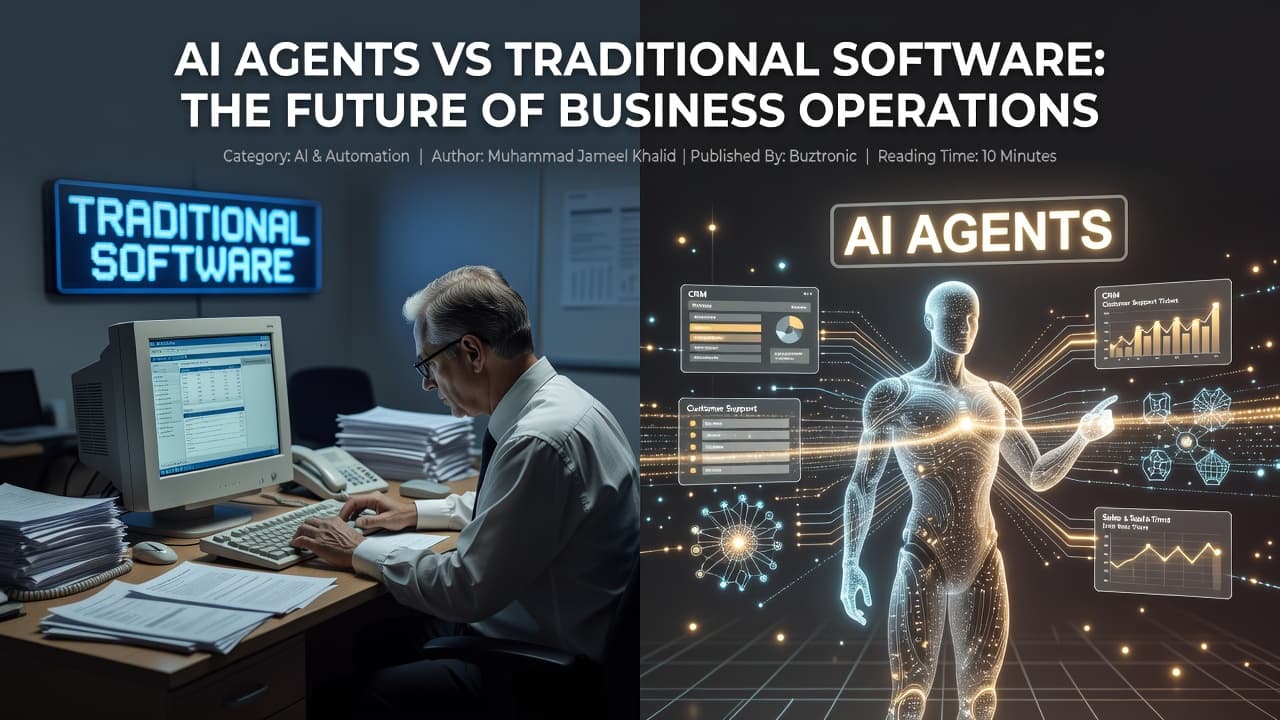
Key Differences Between Traditional Software and AI Agents
Traditional Software
- Rule-based
- User-driven
- Needs manual clicks
- Runs preset functions
- Hard to adapt on the fly
AI Agents
- Goal-oriented
- Can run on their own
- Can make decisions
- Learn from context
- Adapt to new situations
The gap is like buying a tool versus hiring help.
A tool sits until someone uses it.
An assistant works toward the goal you set.
Why Businesses Are Moving Toward AI Agents
Several trends are speeding up adoption.
Growing Work Complexity
Modern businesses use many tools at once.
Examples include:
- CRM platforms
- Chat and email tools
- Marketing software
- Finance systems
- Support apps
Managing all of this by hand wastes time.
AI agents can work across many systems at the same time.
Need for Faster Decisions
Markets move fast.
Businesses must react quickly to:
- Customer questions
- Market shifts
- Daily problems
AI agents can read data and act faster than manual workflows.
Staff Shortages
Many fields struggle to hire.
AI agents offer a scalable way to handle repeat tasks without adding headcount.
That frees people for planning and creative work.
Real-World Applications of AI Agents
Customer Support
AI agents can:
- Answer questions
- Find facts
- Fix common issues
- Escalate hard cases
This cuts wait times and lifts customer satisfaction.
Sales Operations
Sales teams use AI agents for:
- Lead qualification
- Prospect research
- Follow-up automation
- Meeting scheduling
Agents can keep talking to leads without manual effort.
Appointment Management
Clinics, salons, and service firms use AI agents to:
- Book visits
- Send reminders
- Handle reschedule requests
This cuts admin work by a large margin.
Internal Operations
Businesses use AI agents to:
- Build reports
- Watch systems
- Review performance data
- Coordinate workflows
These uses boost daily efficiency across teams.
The Rise of Voice AI Agents
One of the most exciting trends is Voice AI agents.
Unlike chat boxes, voice agents talk on the phone in a natural way.
Examples include:
- AI Receptionists
- Customer support agents
- Appointment booking assistants
- Lead qualification systems
Voice AI lets businesses automate calls that once needed live staff.
Challenges and Limitations
AI agents are powerful, but they are not perfect.
Businesses should plan for:
Oversight Requirements
AI systems need monitoring and clear rules.
Humans should still approve critical decisions.
Data Quality
Bad data leads to bad results.
AI agents need accurate, up-to-date information.
Security Considerations
Businesses must ensure:
- Secure integrations
- Data privacy compliance
- Controlled access permissions
Good setup is essential.
When Should Businesses Use AI Agents?
AI agents work best when:
- Tasks repeat often
- Work spans many systems
- Large data sets need review
- Speed matters
Common examples include:
- Customer support
- Appointment scheduling
- Lead qualification
- Internal reporting
- Operations management
The Future of Business Software
Over the next decade, software will grow more autonomous.
Instead of jumping between dozens of apps, staff will work with AI agents that run those apps for them.
Businesses will move from:
Software-centric work
to
Agent-centric work
This shift will change productivity, scale, and daily efficiency.
Early adopters of AI agents will gain a real edge.
Conclusion
Traditional software still matters. But it is not enough for teams that want top efficiency and growth.
AI agents bring a new model. Smart systems take part in work instead of just sitting in the background.
By automating repeat tasks, speeding decisions, and linking systems, AI agents are changing how companies run.
The future of business will not rely on software alone.
It will rely on systems that can think, plan, and act.
Ready to Build AI-Powered Business Systems?
At Buztronic, we design and develop AI agents, automation systems, SaaS platforms, and intelligent workflows that help businesses scale more effectively.
Book a strategy call today and discover how AI can change your work.